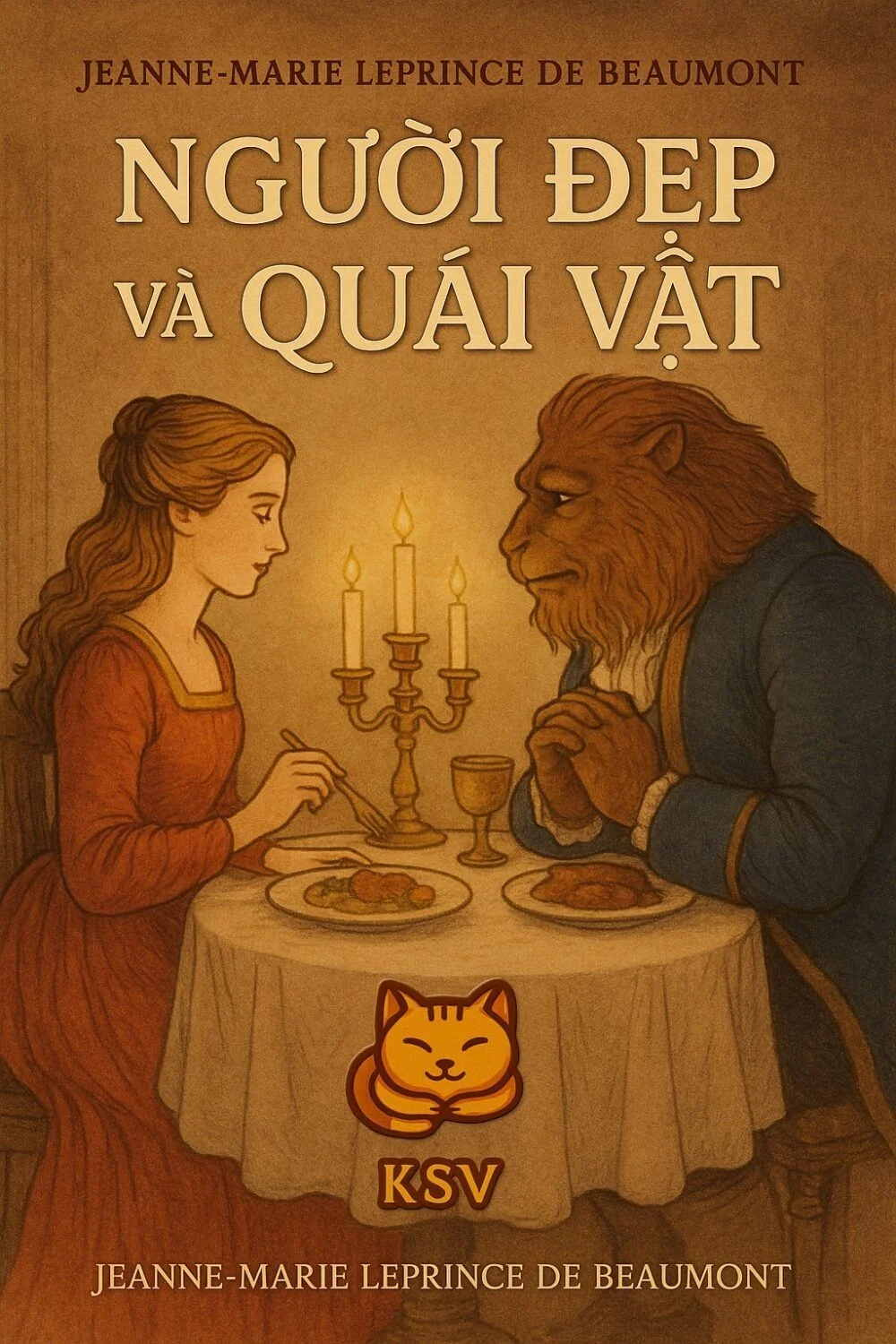
Jeanne-Marie Leprince de Beaumont's Beauty and the Beast sends a merchant's kindest daughter to an enchanted castle in place of her father, who has been condemned for picking a single rose. Beaumont, a French governess writing in 1756, trimmed Villeneuve's novel-length tale of 1740 into a short moral lesson for young readers. It endures because the lesson is gentle and the bargain is strange: a captive learns to see past a frightening face, and the reward for goodness is love rather than rank.
In Vietnamese this is a book of plain, formal storytelling, with dialogue that carries the plot. The thing to watch is xưng hô. The Beast first growls ta and ngươi at the merchant, then softens to a careful cô with Beauty, still calling himself ta. She answers him with a formal tôi and ông, and by the end the two have moved to anh and em. Verse inscriptions in the castle keep their line breaks, and the sisters' spite is voiced in quick, sharp asides.